Be yourself; Everyone else is already taken.
— Oscar Wilde.
This is the first post on my new blog. I’m just getting this new blog going, so stay tuned for more. Subscribe below to get notified when I post new updates.
Be yourself; Everyone else is already taken.
— Oscar Wilde.
This is the first post on my new blog. I’m just getting this new blog going, so stay tuned for more. Subscribe below to get notified when I post new updates.
Recorded at EastWest Studio in Hollywood, Callifornia with co-producer Greg Fidelman (who previously produced the band’s 2014 album .5: The Gray Chapter), it was released on August 9, 2019 by Roadrunner Records. The title is taken from a lyric in the song “All Out Life“, which was released as a standalone single in 2018 and features as a bonus track on the Japanese edition of the album. We Are Not Your Kind is the first Slipknot album to be recorded as an eight-member band, as their former percussionist Chris Fehn departed the band in March 2019 after suing the group for alleged unpaid royalties. After the conclusion of the touring cycle for .5: The Gray Chapter, Slipknot guitarist Jim Root and percussionist Shawn “Clown” Crahan began writing and demoing material for the band’s follow-up album in early 2017. According to Crahan, the group wrote and recorded a total of 22 songs and 26 interludes, with the plan initially being to produce the band’s first double album. Recording began in November 2018, shortly after the release of the standalone single “All Out Life“. The album was completed by April 2019 and “Unsainted” was released as the lead single the next month. This was followed by “Solway Firth” in July, “Birth of the Cruel” in August and “Nero Forte” in December.
Background and writing
Work on Slipknot’s sixth studio album began in February 2017, when the band’s guitarist Jim Root and percussionist Shawn “Clown” Crahan started writing new material together. Speaking to Rolling Stone in November 2016, Crahan simply stated that “we want to write”, but that a recording timeline would remain unconfirmed for the time being. He later elaborated on this plan by claiming that the group’s members wanted to take their time working on new songs, rather than producing it within a set timeframe as they had done before. Plans for the direction of the album had been touted by the percussionist as early as the summer of 2015, when he claimed that he wanted to write an “art record” in the vein of The Wall by Pink Floyd or Sgt. Pepper’s Lonely Hearts Club Band by the Beatles, likely in the form of a double album with an overall concept and numerous interludes. Several song ideas also came from rough demos tracked during the previous tour, with Crahan estimating that the band had “hundreds of ideas”.
Recording and production
After almost two years of writing, Shawn Crahan revealed that recording for Slipknot’s sixth album would begin in November 2018. The full band later joined the percussionist in January 2019. Production was handled again by Greg Fidelman, who engineered and mixed 2004’s Vol. 3: (The Subliminal Verses), and produced 2014’s .5: The Gray Chapter and the 2018 single “All Out Life“. Speaking about working with the producer, vocalist Corey Taylor credited Fidelman with his contributions to their previous releases and noted that “He gets us, he challenges us … we have a great relationship with him”. It was initially suggested in the media that Ross Robinson, who worked with the band on 1999’s Slipknot and 2001’s Iowa, would be producing the album, however this rumor was quickly dismissed by guitarist Jim Root. The recording of We Are Not Your Kind was completed by April 2019, when turntablist and keyboardist Sid Wilson revealed that he was “laying the last” of his parts on the album.
Speaking to British retailer HMV about the album’s recording process, Root recalled that the band spent a lot of time working on initial arrangements for the new material, explaining that “We spent all the time on the demos. We built them and let them evolve.”This allowed the band to “step back” from recordings and revisit them later, leading to what the guitarist described as an “organic” outcome. However, he added that the final tracking process was “a big challenge”, lamenting that “I wish we’d had that time to actually record the album.” Root also distinguished the approach on We Are Not Your Kind from its predecessor .5: The Gray Chapter; he recalled that for the 2014 release “[The] songs came straight from my garage and they don’t have the push and pull of a live band,” contrasting the recording of its follow-up by explaining that “we were playing the songs as a band and tracked them with and without a click track. The ones without click are the ones that we used on the record.
Composition and lyrics
Musically, We Are Not Your Kind has been described as nu metal, heavy metal, groove metal, extreme metal and hard rock.We Are Not Your Kind has been recognized by commentators and band members as one of the most experimental albums of Slipknot’s career. The album features moody instrumentals and electronic elements.During a pre-release interview with Daniel P. Carter on the BBC Radio 1 Rock Show, Corey Taylor claimed that “it is probably the furthest we’ve pushed the boundaries of creativity and experimentation,” adding that “We not only went places that we’ve hinted at musically over the years, but never really went full-board, but we’re also doing heavier things than we’ve ever done. Emily Carter of Kerrang! described it as “the ‘Knot’s most experimental album to date,”NME writer Jordan Bassett called it “Slipknot at their artiest”,and Roisin O’Connor of The Independent claimed that “The sheer ambition of We Are Not Your Kind is just as staggering as their seminal record Iowa“.Several critics highlighted “Spiders” as one of the most avant-garde songs on the album, on which “creepy piano tinklings” and “scattershot drum beats” are favored over the more common low-end guitar riffs.
Another quality of We Are Not Your Kind touted in the build-up to its release was the heaviness of the music. As early as June 2018, Taylor claimed that their sixth album would be “Iowa levels of heavy”. He later reiterated the suggestion, claiming that the album contains one of the heaviest songs of their career.Sam Taylor of the Financial Times admitted that the band “weren’t bluffing” when making such claims, suggesting that the album “often verges on the attritional”.Similarly, Gigwise writer Anna Smith suggested that We Are Not Your Kind featured “some of the heaviest material since [the band’s] eponymous debut“.Reviewing the album for the website Blabbermouth.net, Jay H. Gorania praised the band’s attempts at being heavy on We Are Not Your Kind – describing their first two albums, Gorania opined that “Slipknot seemed as though they were trying to be the heaviest band on the market and trying too hard,” before concluding that “When they are in overdrive nowadays, however, it feels more authentic and expressive.
According to Taylor, We Are Not Your Kind features some of his most personal lyrics to date. During the writing process, the band’s frontman explained that “It’s been a heavy couple of years for me personally. I’ve been able to kind of grab hold of some of the depression that I’ve been fighting and kind of formulate the way that I want to describe it.” Early on in the process, he claimed that “It’s probably the most autobiographical I’ve been in years”, describing the lyrical content as “dark … really dark”. One of the main influences on Taylor’s lyrics was his separation from then-wife Stephanie Luby in 2016; in an interview with Loudwire, he explained that “The narrative [of the album] really came from me working my way through the repercussions of a really toxic relationship. And the fallout that came with finally extricating myself from that relationship.” Another major influence on the album’s lyrical content is that of global “divisiveness”,which Taylor claims is fueled by US President Donald Trump through “bigotry” and “racism”.
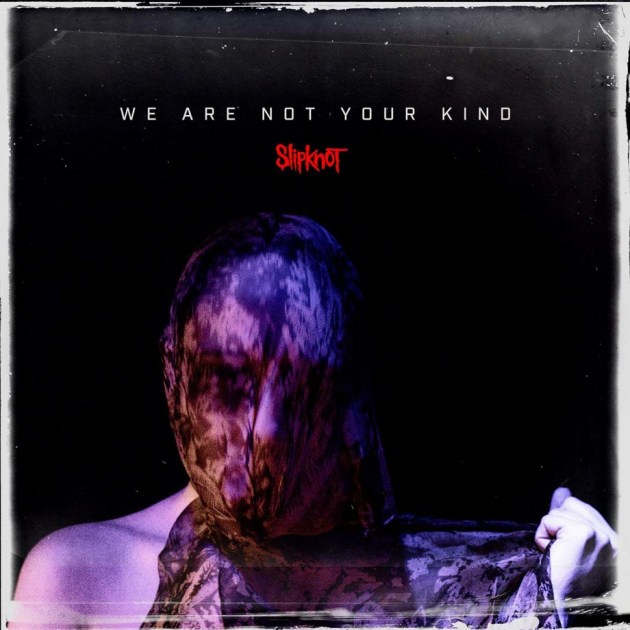
The first notable thing about the new Slipknot album is its intro. A brief piece clocking in at just about 100 seconds, it features none of the hallmark sounds you might associate with the group. There is a static pulse which gives way to curtains of shimmering synths; quickly it feels like it might develop into a Klaus Schulz or Tangerine Dream-style kosmiche piece. The intro is at once cold and spacious, like being immersed in cool water. This gives way to the now well-played Slipknot single “Unsainted,” a song which delivers the standard post-Vol. 3 Slipknot goods but with a knack for sonic detail work and rich heavy guitar tone that feels more modern than the band would technically need. This illustrates that interesting dichotomy of We Are Not Your Kind. Slipknot as a band change far more than a band their size really has any need. And yet, despite how deep and fundamental some of these changes can be and how far afield some of those sonic detours can go, they are still a very large band and thus need to deliver certain consistent elements to maintain their audience. This is at root what causes the at times mixed responses to new Slipknot material within the metal underground. We are at a point historically where there are less people in the metal underground now who have never liked Slipknot than there are people who have once found them appealing; 20 years of consistent presence will do that. Yet it is precisely these consistent elements that inevitably drive certain metal lifers away for much the same reason that the more mainstream metalcore acts like All That Remains lose their more underground fan base over time. However, despite some clear and overt gestures to filling an arena with lit lighters or the paucity of arena metal, Slipknot still manages to capture an oddly artful draw.
Take the track “Birth of the Cruel.” It opens with a sonic passage closer to HEALTH than to Korn before segueing into a classic Soundgarden groove. The middle passage echoes contemporary Gojira (a group that is no stranger to nu-metal sonic concepts). “Birth of the Cruel” is a song that won’t necessarily prove to metal lifer naysayers that Slipknot deserves the amount of acclaim that they receive from mainstream press, but a close ear does at least reveal that there are more interesting ideas here afoot than one might give initial credit for. Slipknot seems to be haunted precisely by the nostalgic image of their sound, an image which hasn’t been accurate since Iowa introduced more explicit death metal and groove metal concepts.
The industrial electronic interlude “Death Because of Death” shows more signs of the post-Vol. 3 methodology of the group where they sought to be a more encyclopedic heavy rock group, one afraid neither of extreme tonalities nor mainstream rock movements while still maintaining a taste for the experimental. Granted, we must dose ourselves; the experiments shown on this record are only experiments in the realm of Slipknot’s body of work and not the overall musical spectrum, and the notes for where these ideas seem to have come from are themselves critically acclaimed groups, diminishing the sense of originality in them.
This is an example post, originally published as part of Blogging University. Enroll in one of our ten programs, and start your blog right.
You’re going to publish a post today. Don’t worry about how your blog looks. Don’t worry if you haven’t given it a name yet, or you’re feeling overwhelmed. Just click the “New Post” button, and tell us why you’re here.
Why do this?
The post can be short or long, a personal intro to your life or a bloggy mission statement, a manifesto for the future or a simple outline of your the types of things you hope to publish.
To help you get started, here are a few questions:
You’re not locked into any of this; one of the wonderful things about blogs is how they constantly evolve as we learn, grow, and interact with one another — but it’s good to know where and why you started, and articulating your goals may just give you a few other post ideas.
Can’t think how to get started? Just write the first thing that pops into your head. Anne Lamott, author of a book on writing we love, says that you need to give yourself permission to write a “crappy first draft”. Anne makes a great point — just start writing, and worry about editing it later.
When you’re ready to publish, give your post three to five tags that describe your blog’s focus — writing, photography, fiction, parenting, food, cars, movies, sports, whatever. These tags will help others who care about your topics find you in the Reader. Make sure one of the tags is “zerotohero,” so other new bloggers can find you, too.

 Kyro's Blog